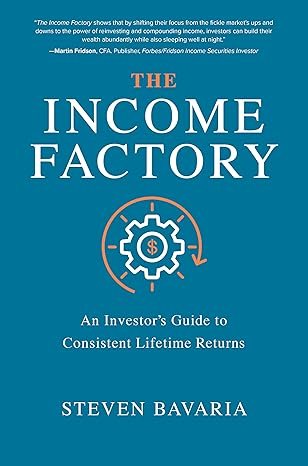
The Income Factory by Steve Bavaria
What if we stopped chasing capital gains and focused on what truly matters: regular income? This is the bet made by Steven Bavaria in The Income Factory, a book that overturns the traditional vision of investing.
Instead of hoping that markets will go up, Bavaria proposes building a portfolio that literally “prints” income, month after month. A simple, patient, and often more reassuring approach than the hunt for quick gains.
I/ How to use this book
This chapter briefly outlines the book’s structure and directs readers to the most relevant sections based on their profile.
II/ Why do we invest ? What makes us wealthy ?
Historically, stock performance was measured by the income generated. Today, price appreciation, or capital gains, is the standard metric. Literature from Charles Dickens or Jane Austen reminds us that income was the primary concern; characters were introduced and classified by their annual income. When we think about our retirement prospects, we also project ourselves in terms of monthly income.
Portfolio growth remains the simplest benchmark for measuring the performance of financial industry players. However, individual investors are by no means obliged to rely on this indicator. The author has chosen to focus on the growth of income flow, rather than portfolio valuation. Based on this strategy, the author drew inspiration from institutional strategies that generate income from credit assets, high-yield bonds, etc. This allows them to achieve returns comparable to stocks without taking on the same level of risk as the underlying asset.
III/ How Mister market captures value
The Income Factory model is simpler than traditional portfolio management: there is no need to witness a rise in profits, which then must be perceived and recognized by the market before finally leading to price appreciation. The increase in dividend and income flow is easier to grasp and predict.
IV/ Income Factory – The Math, the Risks, and the Choices
- The Math: The author provides three examples: a growth portfolio returning 10% per year, a growing dividend portfolio (5% capital appreciation and 5% dividend growth), and a pure income portfolio (0% growth and 10% yield). Unsurprisingly, the final financial result (portfolio value) is the same.
- The Risks: For an income-oriented portfolio, the essential risk is the elimination or reduction of the dividend. For a classic growth strategy, the risk lies in the companies’ inability to grow their earnings over the long term. During a financial crisis, if both portfolios record theoretical paper losses, the income-oriented portfolio allows for the reinvestment of excess cash and the continuation of income flow growth. From this perspective, a bear market represents an opportunity to accelerate income growth.
- The Choices: The author indicates that an Income Factory can be built exclusively from income-oriented assets or can be mixed with companies paying dividends of around 5% that also offer prospects for share price appreciation and dividend growth. He calls this intermediate model the “Light” Income Factory.
V/ What sort of income factory is right for you ?
The author revisits the Rule of 72. A quick reminder: take your yield (e.g., 10%) and divide 72 by that number (72 / 10 = 7.2). In 7.2 years, your capital doubles. The same is true for your income. By reinvesting your dividends, your Income Factory’s output doubles.
The problem with this method is that it is – paradoxically – boring. And most investors have an inner trader. To “fight the boredom,” the proposed method allows you to choose each month which asset to reinvest the income into.
What about the specific risks of this strategy? The risk of traditional portfolio management is the valuation level of the portfolio. For the Income Factory, the major risk is the elimination or reduction of income (dividend cut, default on corporate payments, etc.). As with any investment approach, diversification helps mitigate the risk of default.
This diversification is achieved using various investment vehicles: BDCs (Business Development Companies), high-yield bond funds, corporate credit funds, preferred shares, convertible bonds, etc. The universe is therefore very wide, but also quite technical. Thus, diversification is broad across asset classes, fund types, and investment styles.
Other risks appear: complexity risk (for hard-to-understand vehicles like MLPs and CLOs), credit risk (the risk of default, which the author argues is ultimately lower than the risk of holding equities), and liquidity risk (some assets are illiquid and difficult to sell in a crisis). The author also explains how different U.S. tax treatments affect the net level of return in the context of the Rule of 72.
VI/ Building our factory
The author categorizes the components of his Income Factory by asset type: corporate credit, high-yield bonds, diversified funds, preferred shares, and convertible bonds.
Conclusion
In conclusion, The Income Factory offers a robust and refreshing framework for the income-focused investor. It challenges the dogma of capital gains and proposes a systematic method to build, brick by brick, a portfolio designed to generate growing cash flow, regardless of the moods of Mr. Market.