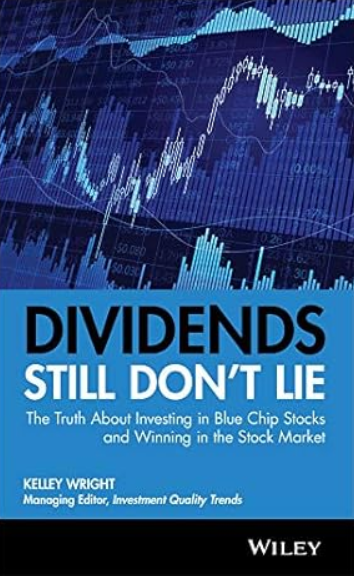
Dividends Still Don’t Lie
Affiliate Link: Buy Dividends Still Don’t Lie on Amazon
A must-have book for income-oriented investors’ libraries.
This book, published in 2010, is the sequel to Dividends Don’t Lie (1989) by Geraldine Weiss, with Kelly Wright taking over to update and expand on the original’s theses. The author’s original premise was that analyzing the dividend yield of “Blue Chip” companies allows an investor to determine if a stock is undervalued (a buying opportunity) or overvalued (a selling opportunity). This reasoning primarily works for large, well-established companies with robust dividend histories.
The thesis is simple: it is easy to manipulate financial and accounting data. However, it is difficult to disguise the consequences of paying a cash dividend. Furthermore, the payment of dividends—and their consistent growth—is a major driver of stock price appreciation. It is for this combined set of reasons that the author asserts that “dividends don’t lie” and can be used as “the central element of a long-term equity portfolio management strategy.”
I/ The Art of Dividend Investing
After discussing financial planning (retirement preparation), Kelley Wright revisits the respective roles of cash (the emergency reserve), bonds (whose vocation is to generate income), and stocks (whose return is the total return, composed of dividends and capital gains).
A concise comparison of long-term stock and bond performance (1926-2008) shows that stocks have the best results. Since few people invest over such a long period, the test is also performed over 10 or 20-year periods. In these scenarios, stocks outperform bonds in the vast majority of cases—though, of course, not in every single one. During the indicated period, stocks generated an annual performance of 9.6%, compared to 5.7% for bonds and 3% for cash (or 7.1%, 2.2%, and 0.5% in real terms after inflation deduction). Kelly Wright concludes that it is preferable to concentrate investments on equities.
Stock performance has three components: price appreciation, the dividend, and dividend growth. The advantage of dividend stocks is that they provide you with cash immediately, whereas “paper” capital gains do not allow you to cover living expenses or even diversify your investments. His stock analysis is based on three indicators: the Dividend Yield, the P/E (Price to Earnings), and the P/B (Price to Book) to assess a stock’s valuation. The dividend yield allows an investor, by looking at a stock’s historical average, to buy at a low price (high yield) and sell at a high price (low yield). As for dividend growth, it helps anticipate future price increases. It should be noted that the strategy relies on a precise investment universe: US blue chips, filtered based on a methodology that includes 6 main selection criteria.
II/ Bargains Still Come in Cycles
The author indicates that dividend yields, like other economic activities, are subject to cycles. The method involves classifying stocks into four categories: undervalued, downtrend, uptrend, and overvalued. The stock price thus moves within a channel between a historically high dividend yield and a historically low dividend yield. This model allowed the classification of blue chips into these four categories and had predictive value, making it possible to anticipate when markets were overvalued and/or undervalued.
Individually, companies have their own valuation channel (overvalued and undervalued yield levels). The individual study of stocks determines the right investment pattern over time. The reasoning can also be extended to the Dow Jones 30—but not the S&P 500, as the latter index does not exclusively contain blue-chip companies. However, even for the Dow Jones 30, structural market changes (expansionary monetary policies, extremely low interest rates, etc.) make the model less operative.
III/ Winning in the Stock Market
The author indicates that the strategy described in the book can suit all types of investors, whether they are growth-oriented—or younger investors—(who will prioritize a low dividend yield and stronger price growth with companies like Nike); or whether they are income-oriented (high dividend yield like AT&T, but with more limited capital gains potential). Other operational recommendations are formulated for individual investors: a portfolio size of 25 stocks, consideration of macroeconomic factors (investing in the mining sector during inflation, taking all economic cycles into account, monetary policy variations, exchange rate variations, etc.). A brief FAQ concludes the book, concretely revisiting the investment principles of the work.
Key Takeaways and Commentary
- Valuable for Income Investors: The book is compelling for income-oriented investors. In my opinion, the framework can be used effectively to determine good entry points (purchase prices) in a long-term investment strategy. However, implementing a rotation strategy seems riskier for a retail investor who wishes to limit the time dedicated to portfolio management.
- The Model’s Evolution: The book’s model may no longer apply as effectively to US market stocks after 10 years of massive monetary injections by the Fed (asset prices have increased, and the high and low bounds of dividend yields have likely shifted lower).
- The Tech Factor: Numerous Tech stocks have emerged and “exploded in value” while paying little or no dividend (Facebook, Google, etc.), which significantly changes the analysis for the Dow Jones in any case.
- Great Fundamentals: The first part contains many principles of common sense that are particularly useful for an investor in the learning phase or anyone wishing to recall the basic principles of investing.
- In short: This is a very interesting book to read in full if you wish to deepen the author’s approach and her technique for classifying stocks and portfolio rotation. Otherwise, this summary provides you with some initial analysis elements of this classic work for income investors.
📚 Ready to Deep Dive into Dividend Strategy?
If you are an income investor, this book belongs on your shelf. Get the full analysis and framework today: